Marten Falls First Nation (MFFN) Community Access Road
June E-Blast 2026
Current and upcoming activities
We want to share the latest updates and progress on the Marten Falls First Nation (MFFN) Community Access Road (CAR). This June 2026 E-blast provides updates on current and upcoming activities, featuring information on the:
- Aboriginal and/or Treaty Rights and Interests: Impact Assessment Reports & Revised Appendix O
- Ministry of the Environment, Conservation and Parks Environmental Assessment Ministry Review
- Impact Assessment Agency of Canada Review: Impact Statement
- Marten Falls First Nation Community Access Road Assessment Process
- Field Work: Species at Risk Surveys
Aboriginal and/or Treaty Rights and Interests: Impact Assessment Reports & Revised Appendix O
As of May 15, 2026, potentially affected Indigenous communities received their own confidential Aboriginal and / or Treaty Rights and Interests (ATRI) Impact Assessment (IA) Report specific to their unique existing conditions and potential impacts. This was followed by the release of an updated ATRI Technical Support Document on May 22, 2026, which summarizes existing conditions and evaluates the potential impacts to ATRI for communities that may be affected by the Project.
Marten Falls First Nation has released a redacted version of their community-specific ATRI IA Report to the public.
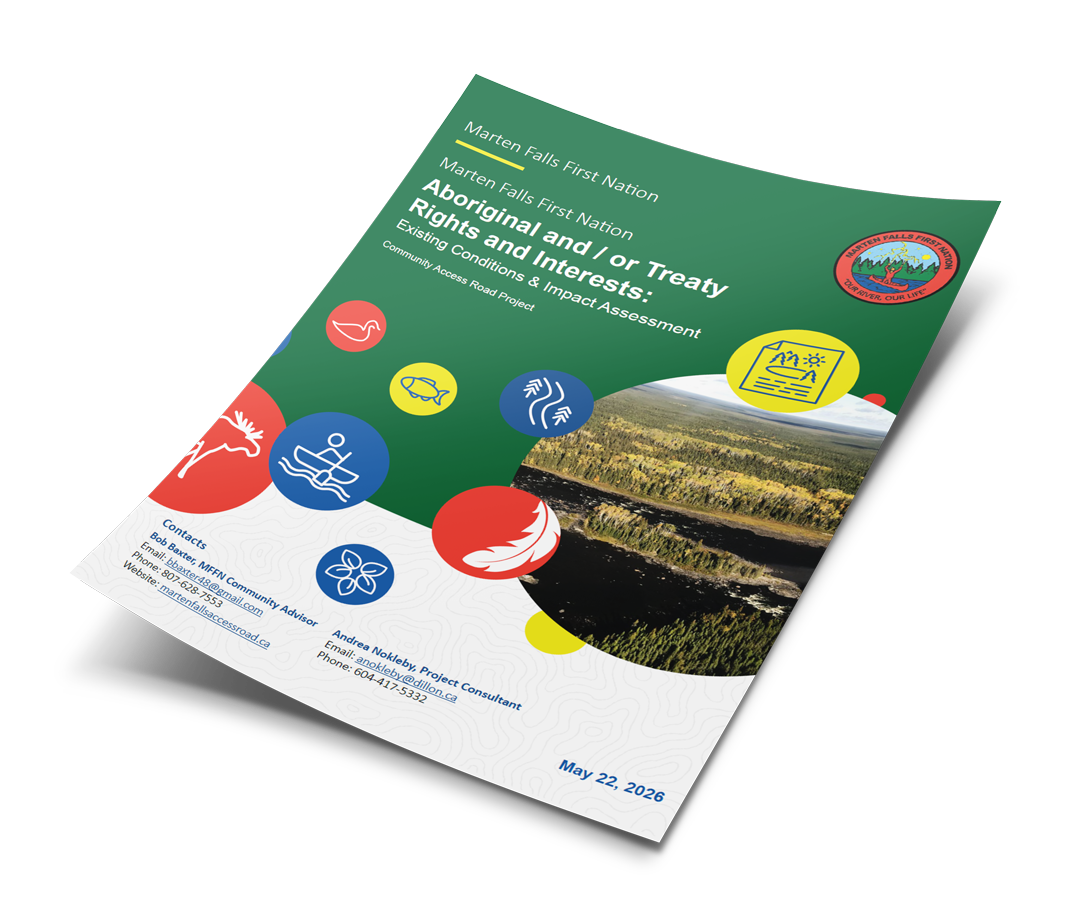
The updated ATRI Technical Support Document includes an overall summary of predicted residual impacts and their severity across potentially affected communities (See Table 7-2 on pages 127-131). The update also includes a letter from Chief Bruce Achneepineskum affirming Marten Falls First Nation’s position on the Community Access Road in relation to the United Nations Declaration on the Rights of Indigenous Peoples (UNDRIP), available in Attachment B. In the letter, Chief Bruce Achneepineskum asserts Marten Falls First Nation’s rights and responsibilities to the land, including their authority to plan, develop, and give consent to projects within their traditional territory.
Ministry of the Environment, Conservation and Parks Environmental Assessment Ministry Review
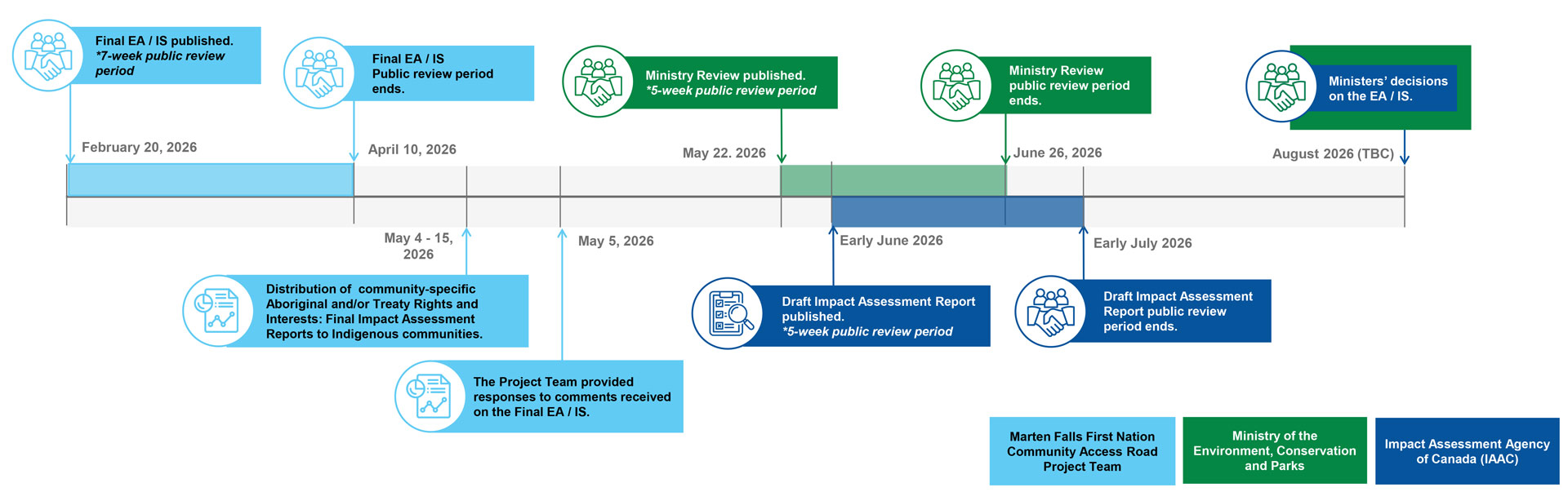
On May 22, 2026, as part of the Environmental Assessment (EA) process, the Ministry of the Environment, Conservation and Parks published the Ministry Review for the MFFN CAR EA. The Ministry Review evaluates whether the proponent has followed the approved ToR and met the requirements of the EAA.
The Ministry Review includes consideration of all comments received from the public, Indigenous communities and government agencies, along with the proponent’s responses. The Ministry Review of the EA is not a decision on the EA. The decision on the EA is made by the Minister of the Environment, Conservation and Parks (Minister) after the comment period is over and there has been consideration of all submissions.
The Ministry Review is now available for a 5-week comment period, ending on June 26, 2026. During this time, interested parties, including Indigenous communities and the public, can submit comments to the Ministry about the proposed project, the EA, the revised Appendix O and/or the Ministry Review.
The Ministry Review is available online:
What’s Next?
After the 5-week comment period on the Ministry Review, the Minister will make a decision on the EA. When making a decision, the Minister will consider the purpose of the EAA, the ToR, the EA, the Ministry Review, the comments submitted during the EA and Ministry Review comment periods, and any other matters the Minister may consider relevant.
The Minister will make one of the following decisions, with the approval of the Lieutenant Governor in Council:
- Give approval to proceed with the project;
- Give approval to proceed with the project subject to conditions; or
- Refuse to give approval to proceed with the project.
The MFFN CAR Project Team anticipates a decision by the Minister in Summer 2026.
Prior to the deadline for submitting comments on the Ministry Review (due June 26, 2026), anyone can make a written request that the Minister refer the application, or a matter that relates to it, to the Ontario Land Tribunal for a hearing. Learn more
Impact Assessment Agency of Canada Review: Impact Statement
At the federal level, the Impact Assessment Agency of Canada (IAAC) is also reviewing the Final EA/IS. IAAC considers the Final EA/IS alongside input from Indigenous communities, the public, government experts, and other jurisdictions. This information is used to prepare an Impact Assessment (IA) Report that assesses federal effects of the project and the extent to which they are significant.
IAAC also develops draft conditions to prevent or reduce adverse federal effects, including technically and economically feasible mitigation measures. IAAC’s draft Impact Assessment Report and potential conditions will be posted on the Canadian Impact Assessment Registry for a public comment period that will be announced at a later. IAAC will consider comments received during the comment period to finalize its report and update the potential conditions.
Then, IAAC will submit its final Impact Assessment Report and the potential conditions to the federal Minister of Environment, Climate Change, and Nature. The Minister must determine, or refer the determination to the Governor in Council who would determine, whether the federal effects are likely to be, to some extent, significant and if any federal effects are likely to be significant whether those effects would be justified in the public interest. This determination is communicated by the Minister to the project proponent in a Decision Statement. The Decision Statement also will include conditions, which the Minister considers appropriate in relation to the adverse federal effects and with which the proponent must comply. The Decision Statement will be posted on the Registry along with the final Impact Assessment Report.
Marten Falls Community Access Road Assessment Process:
Upcoming Field Work – Species at Risk Survey
To support activities related to the continued planning and design of the Marten Falls First Nation Community Access Road, field crews will carry out activities to determine the presence of Species at Risk in the areas around the proposed aggregate sites. Species that field crews will be looking out for are bats, caribou, lesser yellowlegs and short-eared owls. Surveys are expected to start on June 9, 2026.
Field crews will:
- Conduct a helicopter survey within a 1-kilometer radius of select proposed aggregate sites to search for potential bat roosting and hibernation sites and for caribou. If any bat roosting or hibernation sites are located, they will then be surveyed on the ground.
- Areas within 500 m of select proposed aggregate sites will be assessed by helicopter for potential to provide breeding habitat for lesser yellowlegs and short-eared owls. If any potential habitat is noted, those locations will be surveyed on the ground and autonomous acoustic recording units (ARUs) will be set up for a minimum period of 10 days. Caribou observations will also occur as a component of this field work.
- Helicopters will only land in areas of natural clearing, or where helicopter landing sites have been previously established. No new helicopter access is being created as a component of these surveys
The work is scheduled to take place over two rounds of survey visits. The first round of surveys is scheduled between June 9 and June 15, 2026. The second round is scheduled between June 23 and June 29, 2026. The exact survey dates may change due to weather conditions or by how fast the work progresses. Field crews will be accessing sites within the study area around the proposed aggregate sites by helicopter—you may see helicopters in the area.
Get in Touch!
We are on Facebook, LinkedIn and Instagram! Follow us to stay up to date on the Community Access Road.
Please contact us at any time with questions or comments, or to schedule a meeting. Meetings can be arranged in-person in any community, in the Thunder Bay area, or online. We want to hear what you have to say!
Questions or comments? Contact us at 1-800-764-9114 or info@martenfallsaccessroad.ca.